It was a gloomy, rainy autumn day as we embarked on our two day trip to the town of Bihac. Senko, dad of my beloved Anesa, wanted to show us UNA National Park (although I originally desired to go to Višegrad, mainly to check out the steam trains running in Serbia behind the border). Driving through Travnik, I was checking the Czech tourist map app on my phone, the last entertaining (relatively speaking) activity left on my internet-less phone. I noticed that parallel to the road used to run some railroad tracks. I love abandoned railroads (actually I love almost everything abandoned). This one was mysteriously named “Spalatobahn”, as the map showed me, and its remnants soon appeared next to me on the right side of the road in the shape of a low embankment and stone wall.
Czech tourist maps mapy.cz clearly showing railway lines of the past
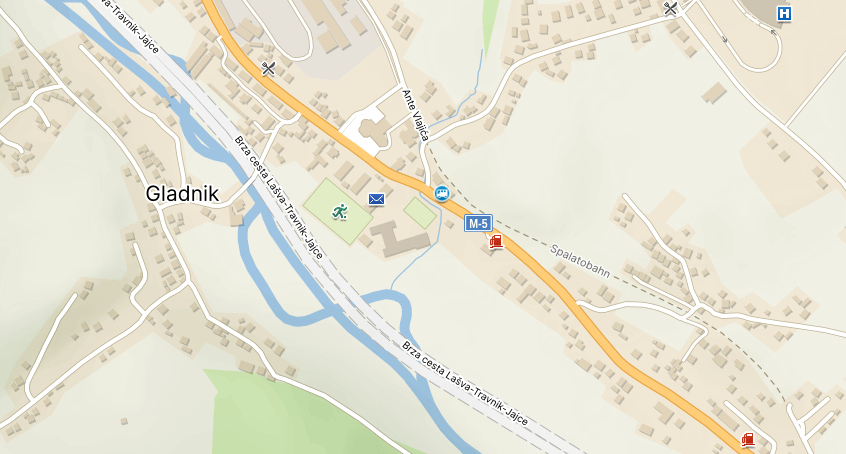
I continued tracking the path on the map, barely hiding my excitement that nobody in the car understood. “I used to go by čiró from Zenica to Jajce as a kid,” said Silvadina, Anesa´s mum from the back seat. After I found out that her memory of this amazing 25 km/h experience has noticeably faded and the only information I received is that čiro means steam train (čiró was actually a nickname for Class IVa/JŽ 83 loco, source: Keith Chester), my excitement disappeared. That is until I saw that we were approaching an abandoned tunnel.
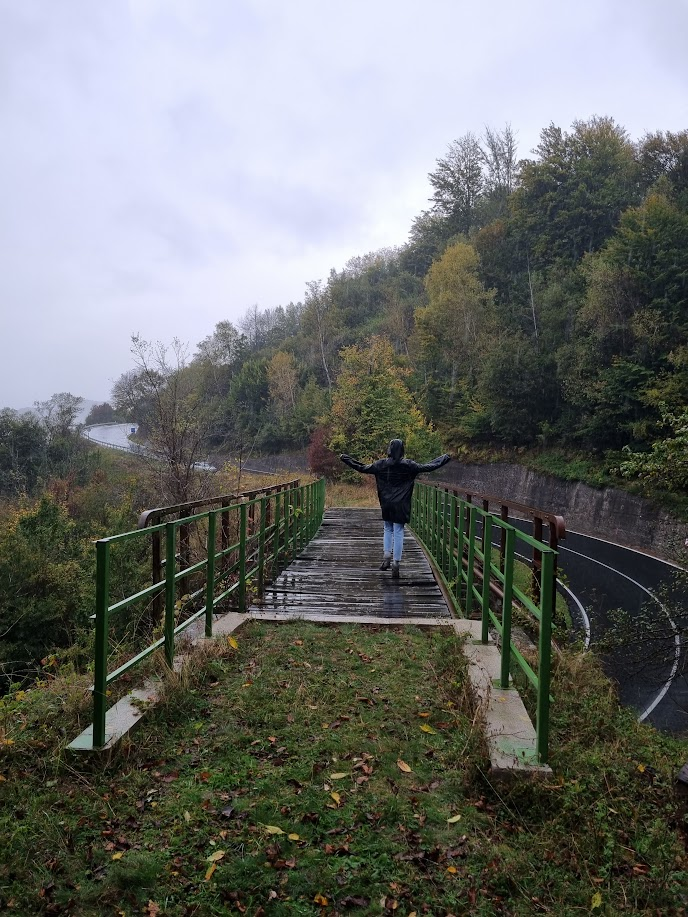
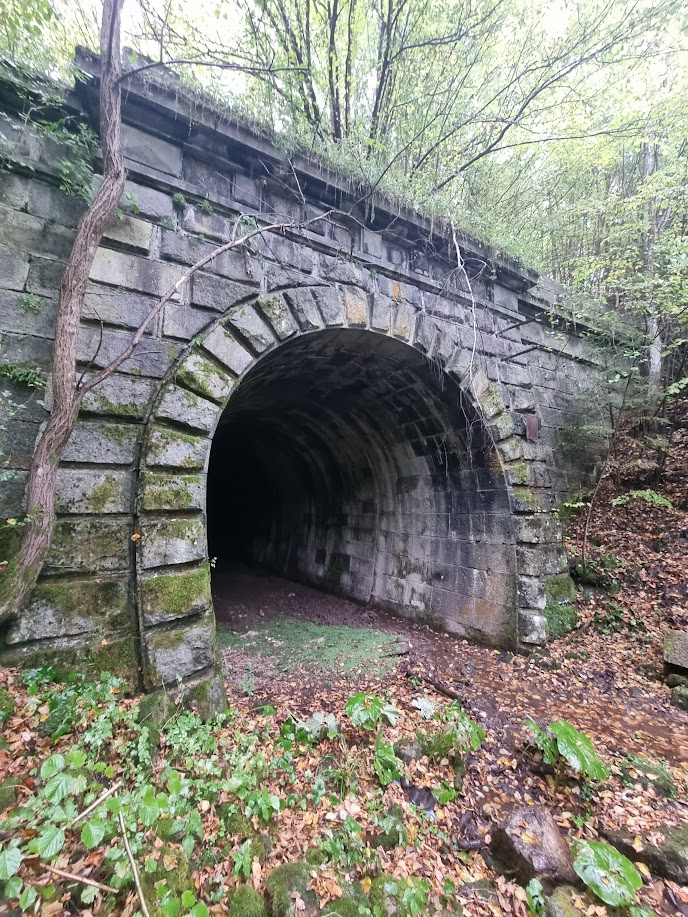
The tunnel was running under the Komar pass and I obviously wanted to explore it, despite the unfavorable weather. After we crossed Komar pass we parked on the side, we put on our Gore-Tex jackets with Anesa and went to explore what was left of the Spalatobahn near its highest point at Komar pass. We went over a steel railway bridge with a strange double railing, which turned out to be Bosnian version of remodeling the used-to-be railroad to a cycle path, crossed a wet meadow with sheep and approached Komar tunnel hiding in the middle of bushes, buried in mud. How one is supposed to cycle here is a question for Bosnian officials. Kudos to Anesa for following me here in the rain, as I can imagine it was definitely not worth the effort for her.
Anesa walking across the original railway bridge with green addition for cyclist
We did not go inside the tunnel that day due to mud everywhere (and from what I understood on one youtube video of a guy cycling the Spalatobahn, the tunnel has collapsed inside anyways). That same day we stopped in Oštrelj, another fascinating place, this time associated with another railroad with foreign sounding name Steinbeis, and once I reached Wifi connection that evening, my ongoing obsession with Bosnian narrow-gauge railway system began. Since then I have spent countless hours studying maps, photomaps, online sources, forums and visiting remnants on site of what used to be the largest and most spectacular narrow-gauge railway network in Europe.
The mouth of the Komar pass tunnel. Notice in what are cyclist expected to ride..
My goal from the beginning was to recreate old photographs from as similar perspective as possible. This, unfortunately, led to two things. Firstly, it affected the resulting pictures in a way that the comparable picture is less interesting or lacks a good composition. I decided to try maintaining the perspective as close as possible to the original, even though some pictures just show greenery or less interesting scenery. This was deliberate: I want to show that everything is fleeting. What was once beautiful is now gone, replaced by something boring or ugly. And this is the second issue: current pictures tend to show Bosnia in a rather unflattering light. Obviously one big aspect is that Bosnia went through a horrible period of history only some 30 years ago, and is still dealing with this past today. But the main point would be that railways simply lost their significance. They went from something the occupier built as a matter of prestige, to show off, as the most important construction projects in the country, to a neglected, forgotten part of history. Train stations went from buildings of utmost relevance, central to every settlement, to neglected areas. The contrast is stark, but the current state of Bosnia is only partially at fault. A big part is simply the drop in relevance. Railways were highways of their time, and if I were to show pictures of newly built Bosnian highways, they would paint a different picture altogether.
Please enjoy my gallery of past places that lost their glory due to the difficult and often sad history of an amazing country named Bosnia and Herzegovina. It will show you not only comparing pictures of what was and what replaced it, but hopefully also illustrate the current life in Bosnia.